Tuesday, March 19, 2013

A Contest?! Yeah, A Contest


The Center for Basque Studies is putting on a writing contest. I've never done this before (and I can't lie and say it was my idea, but I'm definitely putting in the effort organizing it) and I'm scared and excited. Excited because I really want to see if anyone will submit, and what they will submit. I've always loved getting manuscripts, every one a sort of potential—let's face it usually disappointed, but still hopeful—promise. Scared because maybe people will submit and then we'll have to read submissions! But, on the off chance you read this, don't be put off, send us something, we want to hear from everyone out there who might be inspired to write or have a Basque story. Let the Games begin!

Wednesday, March 6, 2013

Memory Landscaping, or Landscaping Memory

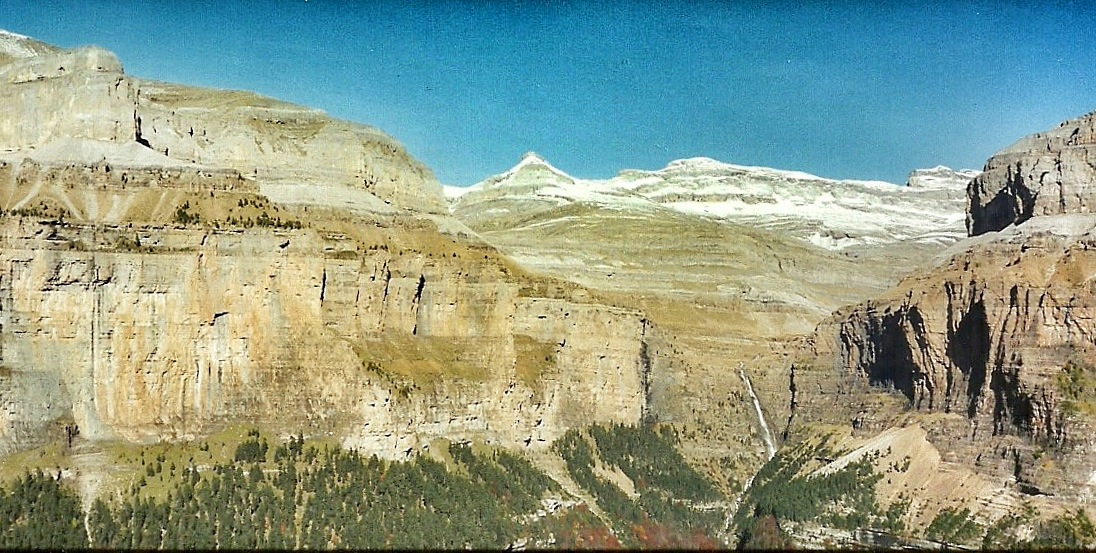
Valle%2520de%2520Ordesa%252C%2520Spain

It was an impressive sight, something I wanted to clip out with scissors and pin to the wall of my memory." —Haruki Murakami, Sputnik Sweetheart

What I remember: the bullring was mostly empty but for old men and derelicts. But what I see when I look at my only surviving photo: at least half women, mostly middle-aged, some young, and one woman standing waving a white handkerchief. What gives?

The blurring and fictionalization of memory.

Patricia Flores, Memory Landscape*

My current writing project depends very heavily on my memory, and my diaries, and some photos (there was a time, unfortunately, when I didn't obsessively document my life in photos), and so I have been thinking a lot about how memory works. In the case of what I'm working on, these are memories from pretty dim recesses of my memory: my days in the Peace Corps in the Dominican Republic, my college days, trips to Chile and Mexico way back in the twentieth century. Why do I remember some things and not others, and—even more importantly—why do I feel that I can trust some memories and others I feel that I have fictionalized, even unintentionally, in my process of remembering?

Even the term "memory landscaping" forms a part of a memory: half discussion half joke years ago to describe one of those fairy tale businesses. The idea was to create memories for people. But beyond that the term stuck with me and, in the process of transformation I have taken it to describe this process not only of disintegration, but also of reintegration: the memory transforms in the way that a beloved landscape changes through time and perception. This is a natural and unavoidable process that we all experience, just as all landscapes eventually change into something else: mountain into a beach, into a seafloor, into a mountain again. With every stage in between:

The past lives on in art and memory, but it is not static: it shifts and changes as the present throws its shadow backwards. The landscape also changes, but far more slowly; it is a living link between what we were and what we have become. This is one of the reasons why we feel such a profound and apparently disproportionate anguish when a loved landscape is altered out of recognition; we lose not only a place, but ourselves, a continuity between the shifting phases of our life. —Margaret Drabble

Before it can ever be the repose for the senses, landscape is the work of the mind. Its scenery is built up as much from strata of memory as from layers of rock. —Simon Schama

It seems to me that the opposite is also true though, the mind is a work of the landscape; layers of memory are built up from the strata of rock. For as long as I can remember, the landscapes of my life had worked a profound sort of magic on me, and in my writing I strive to make the landscape a sort of silent character who is always present: landscaping memory is perhaps just as applicable as memory landscaping.

So I return to the bull ring in Madrid, now empty or filled with ghostlike shadows. It remains, fixed, at the same time that it disintegrates and reintegrates, fills up with smiling women waving handkerchiefs at their favorite matadors.

*I don't have permission to use this artwork, and if anyone would like me to remove it, feel free to contact me directly.

References
Ken Taylor, "Landscape and Memory," Unesco Third International Memory of the World Conference, February 19–22, 2008. Availabale here.

Wednesday, February 27, 2013

Those I Love the Best

Well, this is a bit like a mother telling the world who her favorite child is, but let's face it, while I think everything I work on here at the CBS has its merits, I do have some favorites, which I am going to share with you. (Hope I don't give the others a complex!)

1. Oui Oui Oui of the Pyrenees


From the first time that I read the typewritten manuscript by local Reno native and artist Mary Jean Etcheberry Morton, I was hooked on this story the little Basque girl Maite and beloved goose Oui Oui Oui. Then I saw the illustrations! This book was really a labor of love and I am very proud of it.

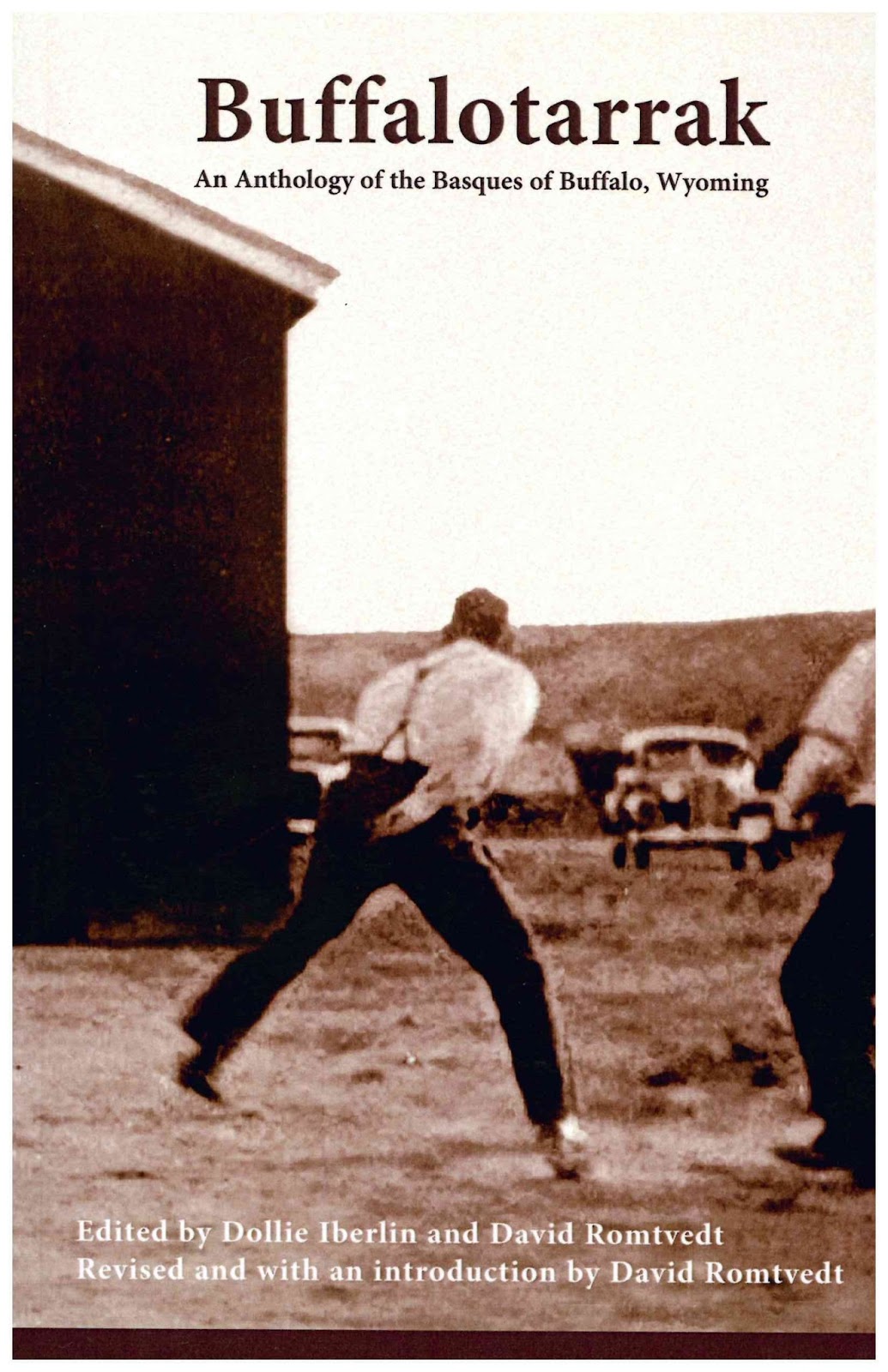
2. Buffalotarrak


Working with editor David Romtvedt is a pleasure, and I really like the Western focus and the fact that these were in the most part essays written by locals of Buffalo, Wyoming make this a fascinating read. While this was published before, we worked a lot on refining the essays and gave it our own imprint. Plus, its title is great! It is a composed Basque word meaning "the people from Buffalo." I think it sounds great!

3. Basque Pelota: A Ritual, an Aesthetic


This is a really interesting study by Olatz Gonzalez Abrisketa in the Basque Country that I think goes well beyond the sport to teach a lot about Basque culture and worldview. But again, I see beyond the text to the work that was put in by everyone involved, the translator, the author, the editors.

4. Our Wars


This collection of stories on violence in the Basque Country contains some of the most important current Basque writers and some of the stories have become personal all-time favorites. But I don't think that is exactly what makes it my favorite. I think it is, as with many of these stories, how much work we put in (myself, the translators, the editor Mikel Ayerbe, the copyeditor and proofreader). At time this book felt like pulling teeth, but the result seems effortless, as good fiction should.

5. Alejandro Aldekoa
This was one of my first books here, and I still find it a good read, even for a book that is pretty heavily musical oriented. My favorite part is how personally involved the author, Sabin Bikandi, got with his subject, the titular dance music master. Through his story one learns much not only about Basque music and dance, but also about Baque culture in general.

The next five:

6. Linguae Vasconum Primitiae. The first book ever published in Basque, by the poet Bernard Etxepare, about whom very little is known, but he spends time not only elevating Basque, but also defending women and celebrating lost loves.

7. War, Exile, Justice, and Everyday Life, 1936-1945. Edited by Sandy Ott, this is excellent history that I would put against anything published by Cambridge, Harvard, or Chicago.

8. Joanes 1 and 2. These could be higher, but we get them pretty much finished, by master graphic artist Guillermo Zubiago. One might notice that a trend in my favorites is how much work I put in, this one is the exact opposite for me, and is also a good reason to love this story of the Basque whaler Joanes. I can't wait for #3!

9. The Basques of Lapurdi, Zuberoa, and Lower Navarre: Their History and Their Traditions. Philippe Veyrin's 1942 classic on the Northern Basques. A little quaint sometimes, but a really readable ethnography, two words that don't always go together.

10. Living Boundaries: Frontiers and Identity in the Basque Country. An excellent anthropological study by Zoe Bray. It could go higher, but also as it was published previously this didn't mean a ton of work for me or the CBS. But an enjoyable read nonetheless, I especially liked the chapter on social interactions, or "going out on the town."

Next up: The Ones to Watch for: Favorites we are working on now!

Saturday, February 23, 2013

Welcome to Chivo Bravo

Hello world, kaixo lagunak, bienvenidos al chivo bravo. Daniel Montero naiz, Renon bizi naiz (sorry my Basque sucks!), I am Daniel Montero, living in Reno, Nevada, born in Winnemucca, Nevada, citizen of the world with stops in Eugene, Oregon; Cuernavaca, Mexico; El Limón, Dominican Republic; Santiago, Chile; New York City; Richmond, Virginia; Miami, Florida; and probably some other places I'm forgetting right now. I have been working at the Center for Basque Studies for the past (almost) five years and have a chance to really make an imprint on the world of publishing about Basque topics in English, I love this little corner of the world.

I got into editing through my desire to be a writer, and I have to admit that for much of the past five years as I've focused on my work I haven't done much writing, but recently I've dusted off the old writing urge and have been spending my nights working on some writing projects. What I am working on right now is a autobiographical "novel" (it's a bit of a genre bender to be honest) provisionally entitled Moving On that deals with four journeys that chronicle the arc of a relationship, a pretty specific relationship to be sure, but also I think/hope the life of relationships together, especially between people who have a hard time being in one place for too long.

So this blog has a simple purpose, to write about these two things that I hold very near and dear to my heart. Entries will be wide-ranging dealing with writing projects, the creative process, book editing and marketing, Basque language classes (which I am in the first year of) and whatever else happens to strike my fancy. This blog will also be featured on my new personal website: www.danielmonteroreno.com and is also a complement to my other blog about adventures in life, La Pedaleada.

And finally, a word about the name. This blog is also dedicated to the cutest, best goat the world has ever seen, Bodie, who graced our life for a way too short of period, Bodie maite zatute.